



11 September 2026
Four premium robotic mowers compared in the 2026 SGS test
SGS compared four premium robotic mowers sold through specialist dealers across 12 real-world challenges. Kress EyePilot achieved the highest weighted score at 4.5 out of 5.
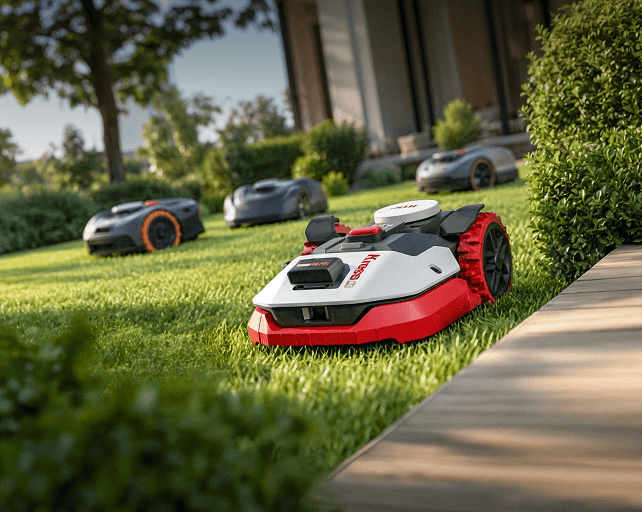
Why these four premium mowers?
The robotic mower market has expanded rapidly. Homeowners can now choose from numerous established brands, new entrants and private-label products sold through home-improvement retailers and online marketplaces.
The SGS comparison focuses on four advanced robotic mowers sold through specialist dealers. They represent the premium end of the market and are aimed at homeowners seeking sophisticated technology, informed product advice, professional installation where required and dependable after-sales support.
It is therefore a focused comparison of four strong candidates within the specialist dealer channel—not a broad survey covering every price point and route to market.
How SGS conducted the comparison
Positec Technology, the company behind Kress, commissioned SGS-CSTC Standards Technical Services—part of SGS, the world’s leading testing, inspection and certification company—to compare four two-wheel-drive robotic mowers under defined conditions.
Testing took place in Sitges, Spain, from 10 February to 17 March 2026. SGS assessed 12 areas of performance, scoring each from 1 to 5 and weighting them according to their contribution to the overall result. The work is documented in report SHES260200276672, issued on 12 May 2026.
The SGS report identifies the three competing products only as Samples A, B and C. For readability, this article refers to them as Mower A, Mower B and Mower C.
This was a comparative performance test, not a product safety certification or a guarantee of performance in every garden.
Overall results
Kress EyePilot achieved the highest weighted overall score at 4.5 out of 5. Mower C followed at 3.8, Mower B at 3.7 and Mower A at 2.5.
| Mower | Weighted score |
|---|---|
| Kress EyePilot | 4.5 out of 5 |
| Mower C | 3.8 out of 5 |
| Mower B | 3.7 out of 5 |
| Mower A | 2.5 out of 5 |
The result came from consistency across the complete test rather than one isolated category. In the published score table, Kress received the highest or joint-highest score in 11 of the 12 test areas. Mower B led the app and user interface assessment, the only category in which Kress did not share the highest score.
| Test area | Weight | Kress | A | B | C |
|---|---|---|---|---|---|
| Initial setup | 5% | 4 | 3 | 3 | 3 |
| Auto-mapping | 10% | 4 | 0* | 3 | 3 |
| Manual mapping | 5% | 4 | 4 | 4 | 4 |
| Professional mapping | 5% | 5 | 4 | 3 | 2 |
| Static obstacle detection | 12.5% | 5 | 1 | 3 | 4 |
| Dynamic obstacle detection | 7.5% | 5 | 4 | 5 | 4 |
| Trap recovery | 5% | 4 | 1 | 4 | 3 |
| Dead-end navigation | 10% | 4 | 1 | 2 | 4 |
| Inter-zone navigation | 5% | 5 | 5 | 1 | 4 |
| Path accuracy | 15% | 5 | 5 | 5 | 5 |
| Signal-loss recovery | 10% | 4 | 1 | 4 | 3 |
| App and user interface | 10% | 4 | 3 | 5 | 4 |
Where the results separated
Setup and mapping
Kress led the initial setup and auto-mapping assessments and received the maximum score for professional mapping. Manual mapping produced no separation: all four systems received 4 out of 5.
The distinction matters because an accurate map defines where the mower should work and which areas it should avoid. Automatic mapping can reduce the work required from an owner, while professional mapping gives trained dealers and installers another way to configure complex or multi-area gardens accurately.
Static and moving obstacles
In the static obstacle test, Kress received 5 out of 5, ahead of Mower C at 4, Mower B at 3 and Mower A at 1. The test included small, medium and large objects and considered avoidance, contact, unnecessary movement and the amount of grass left uncut around an object.
Kress and Mower B shared the highest score in the dynamic obstacle test. SGS assessed each mower’s response to a moving person: whether it avoided contact, slowed or stopped when necessary, and resumed mowing without leaving unnecessary gaps. This assessed navigation behaviour, not product safety.
Recovery and complex navigation
Three tests examined situations that commonly interrupt autonomous mowing: escaping from a confined arrangement of garden furniture, entering and leaving a narrow dead end, and travelling between lawn zones through an S-shaped gravel passage.
The published scores place Kress joint first with Mower B in trap recovery, joint first with Mower C in dead-end navigation and joint first with Mower A in inter-zone navigation. These results are relevant because a mower that cannot recover or move between areas independently may stop before completing the lawn and require the owner to intervene.
Path accuracy
All four mowers received 5 out of 5 for path accuracy, the most heavily weighted category. SGS evaluated the uniformity of the cut, missed grass and the clarity and straightness of the mowing pattern in an obstacle-free area. Open-lawn mowing therefore did not determine the final ranking.
Signal loss
The signal-loss test assessed whether each mower continued operating when GNSS reception was reduced. SGS considered shutdowns, missed cutting, efficiency and the alignment of the mowing pattern. Kress and Mower B shared the highest published score at 4 out of 5, followed by Mower C at 3 and Mower A at 1.
App and user interface
Mower B received the highest app and user interface score at 5 out of 5. Kress and Mower C each received 4, while Mower A received 3. SGS considered setup, installation guidance, mapping, editing, mower control, responsiveness and connectivity.
What the comparison means for buyers
The comparison does not suggest that open-lawn cutting is unimportant. It shows that open-lawn accuracy alone does not distinguish these four premium mowers: every system achieved the maximum score in that category.
The larger differences appeared in tasks that determine how independently a mower can manage a less predictable garden. Buyers should therefore consider the layout of their own lawn, the quality of mapping and obstacle response, the need for professional installation and the support available from a local dealer.
Within the SGS framework, Kress EyePilot delivered the highest weighted overall result. It led or shared the highest score across nearly every test area while also matching all competitors on path accuracy. That breadth of performance, rather than one isolated result, produced its 4.5 out of 5 overall score.
Watch the full comparison
The full video shows all four mowers facing the same test scenarios. The SGS report provides the published methodology, scores and weighting behind the overall result.
About SGS
SGS is the world’s leading testing, inspection and certification company.
It operates more than 2,500 laboratories and business facilities across 115 countries, supported by over 100,000 professionals, and has more than 145 years of experience.
Learn more about SGS >
Frequently asked questions
Kress EyePilot achieved the highest weighted score at 4.5 out of 5. Mower C scored 3.8, Mower B 3.7 and Mower A 2.5.
No. Several categories produced ties, all four mowers received full marks for path accuracy, and Mower B received the highest app and user interface score. Kress nevertheless achieved the highest or joint-highest published score in 11 of the 12 categories.
Positec Technology, the company behind Kress, commissioned the comparison. SGS-CSTC Standards Technical Services conducted the testing and issued report SHES260200276672.
The 12 areas were initial setup, auto mapping, manual mapping, professional mapping, static obstacle detection, dynamic obstacle detection, trap recovery, dead-end navigation, inter-zone navigation, path accuracy, signal-loss recovery and the app and user interface.
No. The scores describe how the tested Mowers performed under the defined SGS comparison. Garden layout, installation, signal availability, software versions and operating conditions can affect real-world results.
Share this article


