




26 October 2026
Obstacle detection: what matters in a real garden?
Detecting an object is only part of obstacle avoidance. How the mower approaches it, controls its clearance and resumes mowing determines both the response and the finish. The 2026 SGS comparison assessed these behaviours with stationary objects and a moving person.
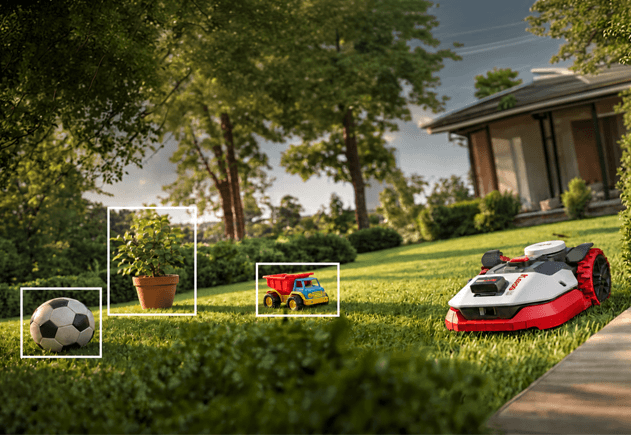
Quick answer
Effective obstacle avoidance requires more than a camera or an AI feature. The mower must detect an obstacle, use the available information to select an appropriate response and control its movement around it.
For stationary objects, this means considering contact, unnecessary manoeuvres and the grass left uncut. For moving obstacles, timing and the ability to slow down, stop and resume mowing also matter.
In the SGS comparison, Kress EyePilot received the highest static obstacle detection score at 5 out of 5. It shared the highest dynamic obstacle detection score with Mower B, also at 5 out of 5.
Why obstacle response matters
A lawn can change between mowing sessions. Garden furniture may be moved, a ball may be left on the grass or a person or a pet may cross the mower’s route.
An accurate map does not account for every temporary object. The mower needs to respond to what is present when it reaches that part of the lawn.
The practical consequences extend beyond whether it stops. Repeated contact can disturb objects. Unnecessary manoeuvres can interrupt progress. Wide avoidance routes can leave patches that need attention afterwards.
Obstacle response therefore affects how independently the mower works and how completely it cuts the accessible grass.
Contact response and detection before contact
A bumper responds to physical contact. When triggered, it allows the mower to stop or change direction.
Detection before contact uses cameras or other sensors to identify an obstruction while the mower is still approaching it. The navigation system can then adjust its movement.
These functions can coexist in the same mower. The relevant distinction is whether the mower can respond before touching an object and how consistently it does so.
A camera alone does not establish that capability. The system must interpret its input and translate it into a timely, controlled response.
Detection, recognition and response
Detection establishes that an object is present. Recognition may help identify what kind of object it is. Other processing may estimate its position, distance or movement.
These are related but separate tasks. A mower does not necessarily need to name an object correctly to avoid it, but it does need enough reliable information to choose an appropriate route or stop.
Camera-based perception can contribute information about objects and the surrounding lawn. Navigation software then determines what to do with it.
That distinction explains why similar feature descriptions can produce different results. Two mowers may both offer AI-assisted obstacle detection, yet differ in when they respond, how closely they pass and how effectively they return to their mowing route.
Why different objects present different challenges
An obstacle test is more informative when it includes a range of sizes and shapes.
A small object may sit low in the grass or be partly obscured. A ball presents a different shape and may move if touched. A chair occupies a larger area, but its individual legs and the spaces between them create a more complex route around it.
Avoiding one large, clearly visible object does not establish how a mower will handle all of these situations.
The SGS static obstacle assessment included small, medium and large objects. This allowed the comparison to consider performance across a defined range of obstacles rather than a single demonstration.
Stationary and moving obstacles require different responses
Stationary obstacles
For an object already on the lawn, the mower needs to detect the obstruction and determine how to pass it.
A useful assessment considers whether contact occurs, whether the mower makes unnecessary movements and how much accessible grass remains uncut around the object.
The task continues after avoidance. The mower also needs to return to productive mowing rather than repeatedly approach the same obstruction or leave an avoidable gap.
Moving obstacles
A moving person changes the situation while the mower is approaching.
The mower may need to slow down or stop, then resume once the route is clear. This tests its response to changing conditions as well as its ability to continue the mowing task afterwards.
In the SGS dynamic obstacle assessment, the moving obstacle was a person. The test considered avoidance of contact, slowing or stopping when necessary, and resuming mowing without leaving unnecessary gaps.
This assessed navigation behaviour, not product safety.
Clearance and mowing coverage
The space a mower leaves around an obstacle affects the result.
Passing too close can lead to contact. Taking a wide route can leave more accessible grass uncut. Repeated reversing and turning may also reduce efficiency without improving coverage.
The useful measure is therefore the complete manoeuvre: approach, avoidance and return to mowing.
Grass directly beneath an object may remain inaccessible regardless of the detection system. The relevant question is how much additional grass the mower leaves around it and whether its movements are controlled and purposeful.
For homeowners, this helps distinguish successful detection from an effective mowing result.
What the SGS comparison showed
The 2026 SGS comparison assessed four premium robotic mowers sold through specialist dealers. Static and dynamic obstacle detection were two of its 12 performance categories.
| Mower | Static obstacle detection | Dynamic obstacle detection |
|---|---|---|
| Kress EyePilot | 5 | 5 |
| Mower A | 1 | 4 |
| Mower B | 3 | 5 |
| Mower C | 4 | 4 |
Kress EyePilot received the highest score in static obstacle detection. SGS considered avoidance, contact, unnecessary movement and the amount of grass left uncut around the test objects.
Kress and Mower B shared the highest dynamic obstacle detection score.
These results formed part of Kress EyePilot’s highest overall score of 4.5 out of 5. Across the complete comparison, Kress received the highest or joint-highest score in 11 of the 12 categories.
The obstacle scores describe performance in the defined scenarios. A maximum score should not be interpreted as proof that every object was avoided without contact or that the same result is guaranteed in every garden.
What the results mean for pets and wildlife
The supplied comparison describes tests with stationary objects and a moving person. It does not establish performance around pets or wildlife.
An animal’s size, posture and movement can differ from the tested obstacles. The results should therefore not be extended into a claim that a mower will detect or avoid every animal.
Obstacle detection is a navigation capability. These SGS results are not a product safety certification or a substitute for the mower’s operating instructions.
What buyers should ask
Before choosing a robotic mower, ask:
1. Does it detect obstacles before contact, and how has that been demonstrated?
2. Has it been assessed with small objects as well as larger ones?
3. How much accessible grass does it leave uncut around an obstacle?
4. Can it resume mowing without repeated approaches or unnecessary manoeuvres?
5. How does it respond when a person crosses its route?
6. What limitations and operating requirements does the manufacturer specify?
A specialist dealer can help relate those answers to the furniture, layout and everyday use of the garden.
Conclusion
Obstacle avoidance is best assessed through the mower’s behaviour: whether it detects an obstruction, responds appropriately and returns to mowing with limited disruption.
Kress EyePilot achieved the highest static obstacle detection score and shared the highest dynamic obstacle detection score in the SGS comparison.
For homeowners, those results provide evidence of performance beyond open-lawn accuracy, where the mower must respond to a garden that changes around it.
Frequently asked questions
Some can, but performance depends on the product and the object’s size, shape, visibility and position in the grass. The SGS static obstacle assessment included small objects, but its scores do not guarantee detection of every toy.
The SGS dynamic obstacle test assessed each mower’s response to a moving person, including avoidance of contact, slowing or stopping and resuming mowing. Kress EyePilot and Mower B shared the highest score at 5 out of 5. This was a navigation assessment, not a safety certification.
No. An AI feature describes part of the system, not a guaranteed outcome. Performance depends on the sensing, interpretation and movement control working together under the conditions encountered.
The object may prevent access to the grass beneath it, while the mower’s avoidance route creates additional clearance around it. SGS considered the amount of grass left uncut as part of the static obstacle assessment.
No. The described tests do not establish performance around pets or wildlife and should not be presented as a safety guarantee.
Kress EyePilot led static obstacle detection outright with 5 out of 5. It shared the highest dynamic obstacle detection score with Mower B, also at 5 out of 5.
Share this article


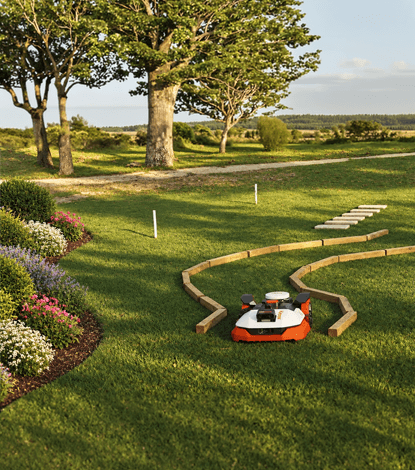
Can robotic mowers handle narrow passages, dead ends and multi-zone gardens?
See how robotic mowers navigate narrow passages, dead ends and separate lawn zones.
9 November 2026
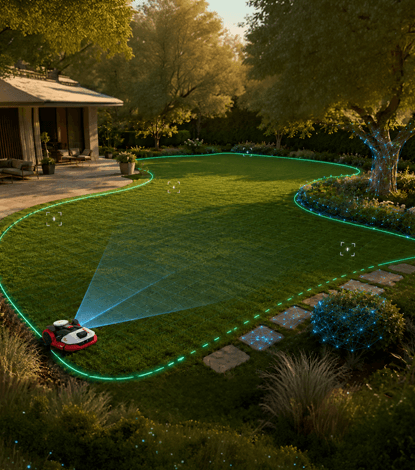
Auto-mapping: how accurately does it define the lawn?
Creating a map is only the beginning. Discover what makes robotic mower auto-mapping truly reliable.
2 November 2026
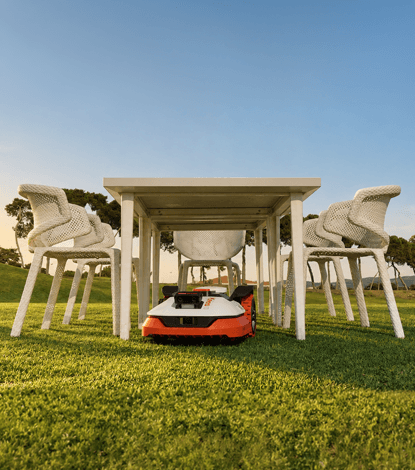
Why RTK alone is not enough for robotic mowing
Precise positioning is only the beginning. Discover what robotic mowers need to navigate independently.
19 October 2026
What happens when a robotic mower loses RTK signal?
Trees, buildings and interrupted correction data can weaken positioning. See how robotic mowers respond.
12 October 2026
Network RTK vs. local base-station RTK: what is the difference for robotic mowers?
Two routes to precise, wire-free mowing. Discover how Network RTK differs from a local base station.
5 October 2026
Four premium robotic mowers compared in the 2026 SGS test
Four premium robotic mowers. Twelve real-world SGS tests. See which came out on top.
11 September 2026


